
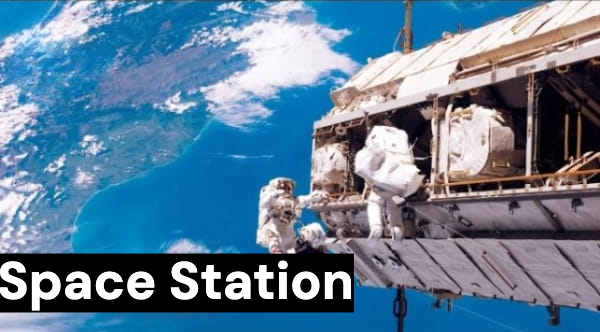
Humanity has always possessed an insatiable curiosity to explore the unknown. Throughout history, this quest has led to the development of various modes of transportation. By means of diverse watercraft, humans first discovered their earthly homes. Subsequently, the invention of aircraft fulfilled the long-held dream of human flight. Ultimately, humans transcended the boundaries of Earth and ventured into outer space. Today, with advancements in technology, we see regular human habitation aboard the International Space Station (ISS).
In this episode, we will delve into the world's largest human-made structure beyond our planet, the International Space Station. Before we begin, I invite those who are new to this channel to subscribe and click the bell icon for updates. [Intro begins]
Throughout history, the most ingenious and courageous individuals have embarked on journeys driven by discovery. Similarly, as humanity ventured into the perilous realm of outer space, it necessitated the utilization of our civilization's most advanced technologies. Through scientific innovation, we have established an unprecedented outpost in space. The International Space Station represents a unique type of artificial satellite where humans can reside. It is a weightless environment where the gravitational pull is so minimal that not only small objects but everything, including humans, constantly floats. In this setting, there is no defined up or down, and the traditional concept of day and night does not apply. This scientific fortress, constructed by human effort, continually travels through the vast darkness of space. Remarkably, the project's inception occurred during a time when computers were less powerful than today's smartphones.
In 1879, a plan for the first space station was conceived by Evryad Hélène. In the early 20th century, Konstantin Tsiolkovsky and Hermann Oberth contributed significant concepts related to this idea. In 1939, Hermann Potocnik developed designs for a potential space station in his work, "The Problem of Space Travel." It took many years to transform the vision of the ISS into reality. In 1984, the United States initiated a space project named Space Station Freedom; however, it was not built according to its original design. After the involvement of several other countries, it was renamed the International Space Station in 1993. Several challenging construction phases have since allowed the ISS to reach its current state, and it continues to evolve.
The International Space Station is the largest human-made structure in outer space. Various sections of the station were constructed in different regions of the Earth and assembled in space. These modules were built with assistance from multiple countries across Asia, Europe, and North America. Three types of rockets were utilized to transport these modules from Earth to the construction site in space: the American Space Shuttle, the Russian Proton rocket, and the Russian Soyuz rocket. The construction of the space station would not have been feasible without these rockets. More than thirteen years were required to build this floating human fortress in space. The initial phase involved connecting two separate American and Russian space stations. Due to differences in technology between the two nations, the stations were challenging to link. A specialized converter, known as the Pressurized Mating Adapter (PMA), was then developed to facilitate this connection. In 1988, the two space stations were successfully joined using the PMA; however, it was not yet suitable for human habitation.
Continuous development of the station persisted until the year 2000, when astronauts began regular habitation. Since then, the space station has never been uncrewed.
Currently, six astronauts are permanently stationed aboard the ISS, primarily conducting scientific research that can only be performed in space. Generally, astronauts remain on the ISS for six months; however, some crew members may stay for nearly a year. Research is conducted on the physiological changes the human body undergoes due to prolonged absence from Earth. The ISS measures larger than a football field, and its interior space is comparable to a six-bedroom house.
Fifteen countries currently conduct research and operations from the International Space Station, including the United States, Canada, Russia, Japan, and eleven nations affiliated with the European Space Agency (ESA). The ESA member countries include the United Kingdom, Germany, France, Spain, Norway, Sweden, Italy, Switzerland, the Netherlands, Belgium, and Denmark. Due to the participation of skilled researchers from multiple nations, the ISS has effectively transformed into an international scientific research laboratory. Over the past three decades, more than three hundred astronauts have worked on the space station. Unfortunately, two accidents during re-entry have resulted in the loss of fourteen astronauts, serving as a stark reminder that each space mission carries potential risks despite extensive safety precautions and preparations.
Research conducted aboard the ISS has significantly enhanced humanity's understanding of the universe. Notably, scientists residing in the ISS are diligently addressing the challenges that humans may encounter during future deep-space expeditions.
The International Space Station travels at a speed of 28,000 kilometers per hour, completing an orbit around Earth in just 92 minutes. It orbits relatively close to Earth, and as it continues its journey, it occasionally approaches even closer. Without necessary interventions, the ISS would enter Earth's atmosphere at high speed, causing catastrophic combustion due to the friction with atmospheric entry. To prevent such disasters, the station is periodically propelled upward using specialized technology to maintain its designated orbital path.
This triumph of human space exploration undoubtedly represents an unforgettable achievement for civilization, originating from the inception of aircraft. The history of aircraft invention is essentially a tale of intense rivalry. On one side were the pioneering Wright brothers—Wilbur and Orville—while on the opposing side was Glenn Curtiss, a motorcycle manufacturer. To learn more about how the invention of the airplane unfolded amidst this rivalry, please watch this video on "What, Why, How." If you are new to the "What, Why, How" channel, feel free to explore our other videos. To receive regular updates on similar content, please subscribe. To be notified as soon as our next video is uploaded, don’t forget to click the bell icon next to the subscribe button. If you found this video interesting, please like it and share it with friends. We encourage you to comment below about where you regularly watch our videos. Thank you.